
Strong Pilates reformer manufacturer quality control starts with one approved product definition—not just one finished sample. Freeze the model specification and order-specific bill of materials (BOM), approve physical color and material samples, retain a signed golden sample, identify material lots, require written approval for every change, and inspect incoming materials, production stages and finished units against the same revision.
Absolute zero color variation is not a realistic promise across upholstery, paint, wood and other materials. A professional system defines what must remain identical, what variation is acceptable, how it will be checked and who can approve an exception before production continues.
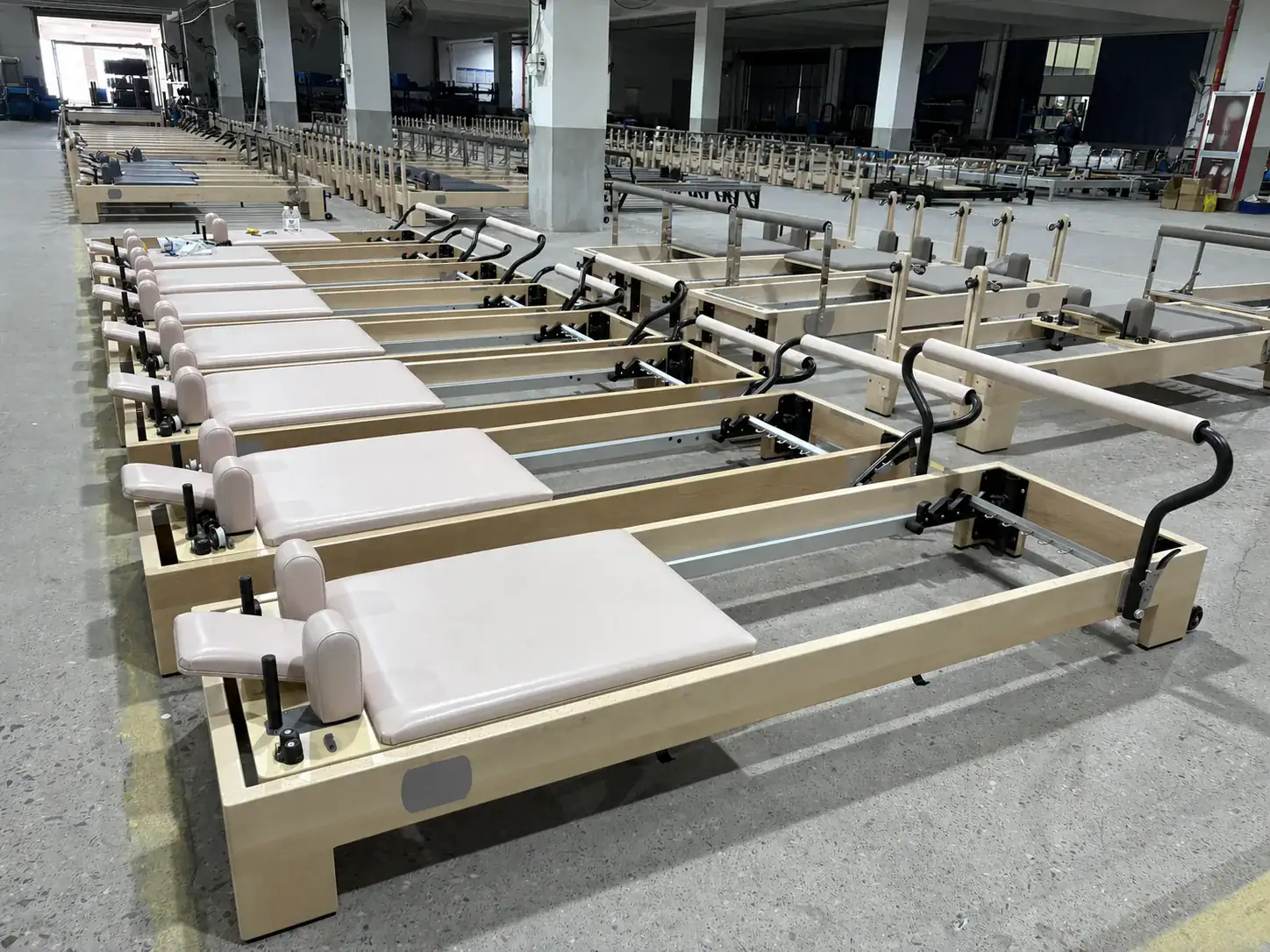
When evaluating a Pilates reformer manufacturer, production consistency matters most to mature brands, distributors and multi-location studio groups. A repeat order that is mechanically sound can still create a commercial problem when upholstery tone, frame finish, logo position, spring configuration, accessories or packaging no longer matches the first batch.
The goal is not to eliminate every natural material difference. The goal is to make every important requirement traceable and reviewable, so buyers can distinguish an approved variation from an uncontrolled substitution.

Why Pilates reformer batches vary
A reformer combines components from different processes: timber or metal frames, coatings, upholstery, foam, hardware, springs, ropes, straps, plastics, labels and cartons. Each input can change independently. Even when the model name remains the same, a new material lot, supplier, surface finish or undocumented substitution can shift the final appearance or function.
| Variation source | What can change | Required control |
|---|---|---|
| Upholstery lot | Hue, gloss, grain, stretch, thickness or surface feel. | Material code, supplier, lot record, physical swatch and approved comparison method. |
| Paint or powder-coating batch | Color, gloss, texture, film appearance or match between separate metal parts. | Color reference plus substrate, finish, supplier formula or code, and approved sample panel. |
| Wood | Grain, natural tone, stain absorption and visual contrast between pieces. | Wood species/grade, finish system, approved range and placement rules for visible faces. |
| Hardware or functional component | Dimensions, finish, load behavior, compatibility or adjustment range. | Drawing/specification, approved supplier or equivalent criteria, incoming inspection and fit test. |
| Production instruction | Hole position, logo placement, stitching, assembly sequence or packing layout. | Controlled work instruction with revision and measurable acceptance points. |
| Unapproved substitution | A component can look similar but behave differently or conflict with spare parts. | Formal deviation request and buyer approval before use. |
1. Lock the specification and order-specific BOM
The master specification should describe the sellable configuration in enough detail for purchasing, production and quality teams to build the same product. It should not rely on a sales photo or a message thread.
For a private-label or customized reformer, the BOM should be specific to that buyer and model revision. It should identify materials, component codes, quantities, approved suppliers where relevant, colors, finishes, logo method, included accessories, labels, packaging and compatible replacement parts.
| Specification field | Weak description | Controlled description |
|---|---|---|
| Upholstery | Beige leather | Supplier, material series/code, color code, grain/finish, approved swatch ID and lot requirement. |
| Frame finish | Black | Material/substrate, coating type, approved color reference, gloss/texture reference and sample panel ID. |
| Springs | Standard spring set | Quantity, resistance identification, color marking, dimensions or part numbers, and model compatibility. |
| Logo | Customer logo | Artwork revision, dimensions, position, orientation, color, application method and approved proof. |
| Packaging | Export carton | Carton/crate construction, protective parts, accessory position, labels, carton count and packing reference. |
Give the specification and BOM a revision number and effective date. The purchase order, production traveler, inspection checklist and packing list should all point to that same revision. If one document still references a standard configuration while another contains custom changes, production can follow the wrong instruction even when every team believes it is working correctly.
P.E.Pilates has previously documented a real final-quality-control case where an approved sample and production BOM disagreed. The corrective action was to use an order-specific BOM and verify spring color, quantity and resistance as separate checkpoints. That example is included in our guide to choosing a Pilates reformer manufacturer.
2. Create a golden sample and reference set
A golden sample is the approved physical product—or an agreed controlled first article—that represents the intended configuration. It should be retained and protected so later batches can be compared with the approved reference rather than with memory, catalog photography or an older production unit that has aged in use.
The reference set can include more than one complete reformer:
- Signed upholstery swatch with material and color codes.
- Painted or powder-coated panel showing color, gloss and texture.
- Approved wood sample or a documented acceptable visual range.
- Logo proof and physical logo component.
- Approved spring, rope, strap, pulley and carriage-wheel references.
- Photos with measurements for placement, stitching and packaging.
3. Define color with physical samples and controlled conditions
RAL, Pantone or a supplier color code can provide a common starting point, but a code alone does not define the complete product appearance. Substrate, gloss, texture, coating thickness, grain and lighting affect how a color looks. RAL itself advises using a physical color sample for final decisions because digital display is only an approximation.
For higher-volume or appearance-critical projects, buyers and suppliers can agree on instrumental color measurements. ISO/CIE 11664-4 defines the CIE L*a*b* color space and methods for representing color differences. ASTM D2244 also states that purchaser and seller should agree on both the permissible tolerance and the calculation procedure, while correlating instrument results with visual appraisal.
| Color-control record | What to specify |
|---|---|
| Reference | Physical swatch/panel ID, supplier code and any agreed RAL or other color-system reference. |
| Material and surface | Leather or synthetic upholstery series, coating type, wood finish, gloss level, grain and texture. |
| Viewing conditions | Lighting source/booth condition, viewing angle, background and comparison distance where relevant. |
| Instrument method | Instrument, geometry, illuminant/observer, color-difference formula and measurement locations if used. |
| Acceptance | Written visual range and/or agreed numerical tolerance, including who can approve borderline results. |
| Lot decision | Material lot number, sample result, disposition and linkage to finished-unit batch. |
4. Control material lots and traceability
When visible surfaces must match across a studio or dealer order, use the same approved material lot for adjacent or customer-visible units whenever practical. Mixed lots can create a noticeable contrast even when each lot is individually acceptable.
Traceability does not require a complex software system. At minimum, connect the purchase order and production batch to the supplier, material code, lot number, receiving date and inspection result. For finished products, keep the batch or unit identity linked to the relevant material and component records.
This becomes important when a brand needs to reorder one replacement upholstered part months later. The original lot may no longer exist, so the supplier should confirm whether the replacement is expected to match exactly, fall within the approved range or require replacing a paired set for a visually consistent result.
5. Require written change approval
Supplier changes can be necessary. A material may be discontinued, a part may improve, or a regulation may affect an input. The risk is not the existence of change; it is change that reaches production without impact review and buyer approval.
A change request should identify:
- The current part/material and proposed replacement.
- The reason for the change and proposed effective batch.
- Effects on appearance, dimensions, function, safety, compatibility, packaging, documentation and spare parts.
- Comparison evidence, test results and photos or samples.
- Existing inventory disposition and whether mixed versions could ship together.
- Required approvals and updated document revisions.
ISO guidance on documented information for ISO 9001 identifies records for unique identification when traceability is required and records of production/service change reviews, authorizers and resulting actions. A supplier does not need to publish confidential internal records, but the buyer should be able to see the controlled result relevant to the order.
6. Inspect at incoming, in-process and final stages
Final inspection alone cannot efficiently correct every consistency problem. By the time upholstery, frame finish and hardware meet in final assembly, rework can be expensive and the original material lot may be gone.
| Stage | Consistency questions | Typical evidence |
|---|---|---|
| Incoming materials | Does the code, supplier, lot, appearance and key dimension match the approved input? | Receiving record, lot label, swatch/panel comparison, measurement or certificate where applicable. |
| First article / line start | Is production using the correct revision, tooling, logo placement and custom configuration? | Signed first-piece check, photographs and measured positions. |
| In-process | Are components being installed consistently, and are lots or versions being mixed? | Traveler/check sheet, station checks and exception record. |
| Final unit | Does appearance, function, accessory set and labeling match the approved specification? | Final QC checklist, functional test and unit photos. |
| Batch comparison | Do units placed together show unacceptable visual or configuration differences? | Group photos under consistent lighting and comparison with retained references. |
| Packing release | Are the correct units, accessories, labels and documents entering the shipment? | Packing photos, carton/pallet identity and release record. |
Our Pilates reformer quality inspection checklist for bulk orders covers a single shipment’s frame, carriage, springs, ropes, pulleys, footbar, upholstery, accessories and packing. This article adds the cross-batch controls needed for repeat orders. P.E.Pilates records 100% outgoing quality control for applicable final checkpoints; the exact inspection scope still depends on the model, configuration and order.

7. Review the first unit before completing a repeat batch
A repeat order should not move directly from purchase order to full production simply because the model was built before. Confirm the current revision, unavailable materials, approved changes and retained references first. Then inspect a first unit or first assembled set before the remainder of the batch is completed.
For appearance-critical orders, review both close-up details and several units together. A small difference may be acceptable on separate deliveries but highly visible when ten reformers sit in one mirrored studio. The order documents should define whether matched grouping is required.
Repeat-order consistency checklist
| Before production | During production | Before shipment |
|---|---|---|
| Confirm model and BOM revision. | Verify material codes and lot identities. | Compare finished units with the golden sample. |
| List every change since the previous order. | Approve the first article or line-start unit. | Review units together for visible batch variation. |
| Confirm physical color/material references. | Record substitutions and stop unapproved use. | Check logo, labels, accessories and packing revision. |
| Define tolerance and comparison method. | Link in-process records to the order/batch. | Keep inspection and packing evidence. |
| Identify parts needing compatibility continuity. | Separate lots or revisions where mixing is prohibited. | Record approved deviations before release. |
Questions buyers should ask a long-term supplier
- Which document controls the current sellable configuration?
- Does each private-label order use a customer-specific BOM and revision?
- What physical samples are retained, and how are they identified?
- How are upholstery, coating and other material lots linked to the production batch?
- Which changes require buyer approval before production?
- How are first-article, in-process, final and packing checks recorded?
- How will a replacement part be matched to the original model revision?
- What happens when the original color or component is discontinued?
For customization planning before the first order, see our Pilates reformer OEM/ODM guide. Brand owners can also use the private-label Pilates reformer launch guide to connect sample approval, documentation, production release and after-sales support.
Frequently asked questions
How do manufacturers keep reformer colors consistent?
They define the material and finish precisely, approve physical swatches or panels, record supplier and lot information, compare incoming materials and finished products under controlled conditions, and require written approval when a material or process changes. A color name or online image alone is not a sufficient production standard.
Can upholstery colors vary between batches?
Yes. Upholstery can vary in hue, gloss, grain, texture and other appearance factors between production lots. Buyers and suppliers should agree on a physical reference, acceptable visual or measured tolerance, lot-control method and how replacement parts will be handled.
What is a golden sample?
A golden sample is an approved physical product or controlled first article retained as a comparison reference for future production. It should be labeled with the customer, model, revision, approval date and approver and stored so aging or handling does not invalidate the comparison.
Is a RAL code enough to guarantee an exact match?
No. A RAL reference improves communication, but substrate, gloss, texture, coating process and lighting affect appearance. Final approval should use the relevant physical sample or panel and an agreed comparison method.
How should product changes be approved?
The supplier should submit a written change request describing the current and proposed inputs, reason, effective batch, impacts, evidence and inventory disposition. The authorized buyer and supplier representatives should approve it before the new version enters production, then update the BOM, specification and inspection documents.
What should be checked on a repeat order?
Confirm the model/BOM revision, all changes since the prior order, physical color and material references, current suppliers and lots, first-article result, component compatibility, final batch comparison, accessories, labels and packing. Do not assume the previous order automatically defines the current one.
Request a repeat-order specification review
Send P.E.Pilates your model, previous order reference, target quantity, required colors, branding and any proposed changes. We can review the applicable product specification, sample references, inspection points and production approval path before the repeat order is released.
References and scope
Color-control guidance in this article references RAL’s physical sample guidance, ISO/CIE 11664-4:2019 and ASTM D2244. Change-control and traceability principles reference ISO guidance on documented information for ISO 9001:2015. Exact tolerances, materials, inspection scope and records must be confirmed for the model, surface, market and written order.