
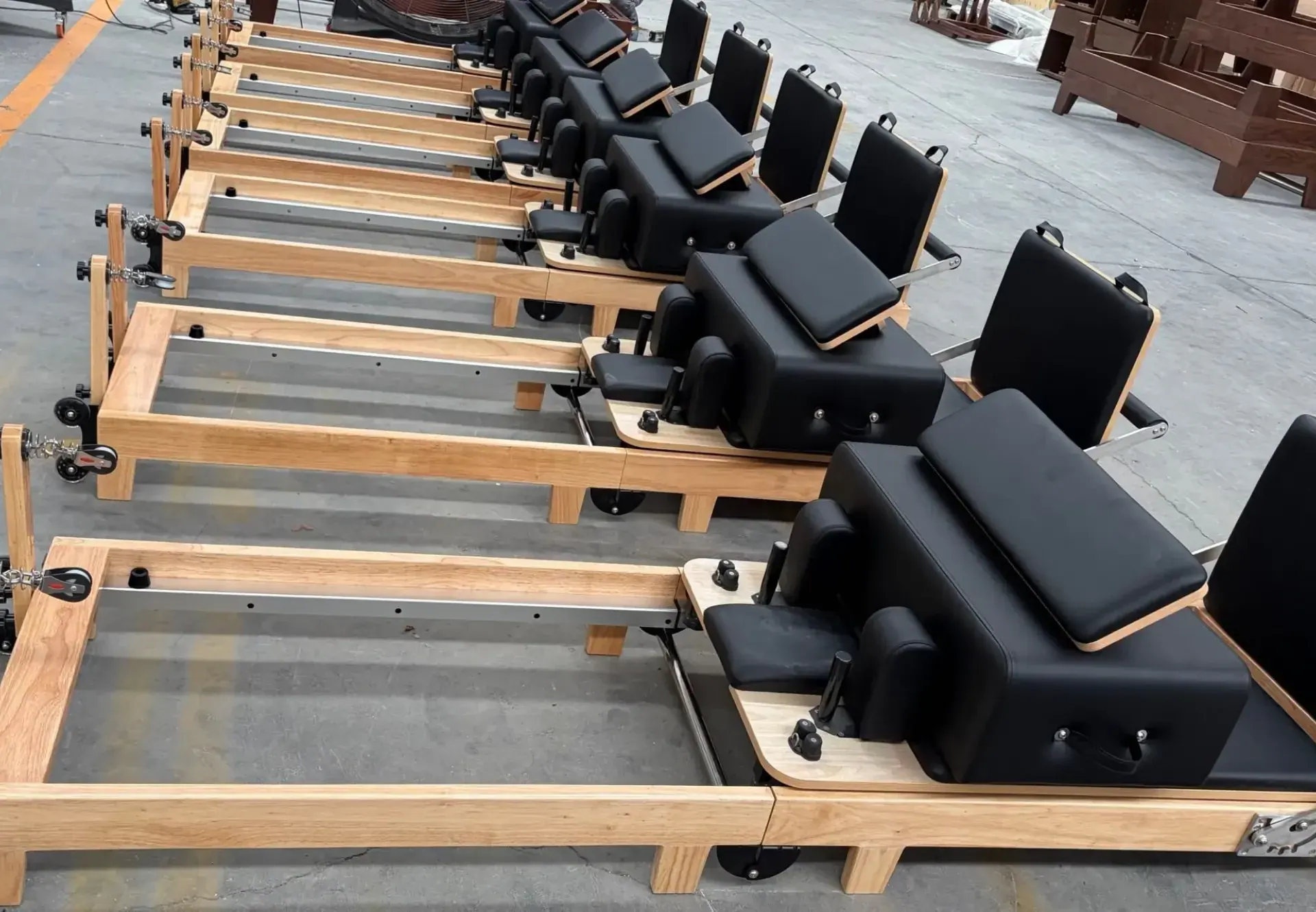
A factory-process video can show that a supplier has access to equipment, people and an assembly workflow, but it cannot prove that your order will use the same materials, tolerances or quality controls. Buyers sourcing a Pilates reformer in China should use production footage to identify the stages that matter, then request an approved specification, first-article approval, in-process records, functional inspection and packing evidence for the exact model and order.
The most useful question is not “Does the factory look busy?” It is “How does this factory keep the approved product unchanged from incoming materials to the unit that enters my shipment?”
The video below, Pilates Reformer Machine Factory Mass Production Process in Korea, gives buyers a useful visual reference for reformer manufacturing. P.E.Pilates’ documented workflow provides the order-control context: material inspection, material processing, surface finishing, component assembly, functional testing, final quality inspection, protective packaging and shipment release.
P.E.Pilates also documents four quality checkpoints—IQC, IPQC, FQC and OQC—and states that each reformer receives quality and functional inspection before shipment. The applicable final checkpoints receive 100% outgoing quality control; the exact scope depends on the model, configuration and order.
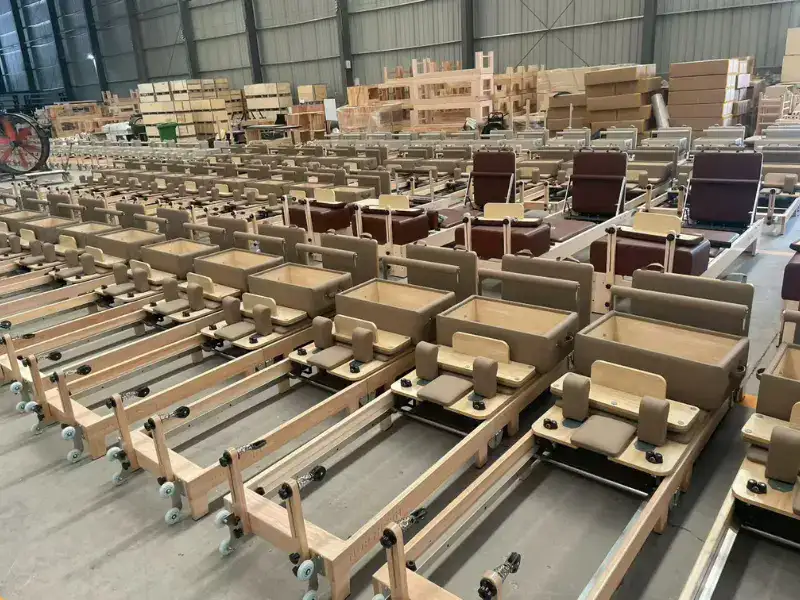
P.E.Pilates manufacturing process at a glance
| Stage | Work scope | What the buyer should connect to the order |
|---|---|---|
| 1. Material inspection | Incoming inspection of wood, aluminum, springs, upholstery and hardware | Approved material or component identity and incoming-inspection record |
| 2. Material processing | Wood and metal structural processing | Current drawing or specification, first-piece result and key measurements |
| 3. Surface finishing | Sanding, painting or spraying, and other surface treatment | Approved physical finish reference and acceptable appearance range |
| 4. Component assembly | Installation of rails, carriage and functional parts | Order-specific configuration, assembly checkpoints and traceable exceptions |
| 5. Functional testing | Movement, resistance and structural checks | Defined method, applicable acceptance result and identified product |
| 6. Final quality inspection | Finished-product inspection before packing | Completed checklist tied to the model, configuration and order |
| 7. Protective packaging | Product protection and accessory verification | Approved packing method, accessory list and pre-closing photos |
| 8. Shipment release | Shipping review and dispatch | Outgoing inspection report, shipment identity and release evidence |
What the factory video can—and cannot—tell a buyer
Production footage is valuable because it turns a finished product into a sequence of controllable steps. Buyers can see that a reformer is not one component. It combines a structural frame, moving carriage, wheels or bearings, guide surfaces, springs, ropes, pulleys, upholstery, adjustment hardware, accessories and protective packaging.
However, video is evidence of activity, not automatically evidence of control. It rarely identifies the drawing revision, material grade, component supplier, acceptance tolerance, inspection result or order number. A polished factory tour can therefore support due diligence, but it should not replace it.
| What production footage may show | What it does not prove | Evidence to request |
|---|---|---|
| Frames or structural parts being prepared | The exact material, dimensions and revision used for your order | Approved drawing, material specification, BOM and measured first-article record |
| Sanding, coating or surface finishing | Finish durability, color consistency or approved surface standard | Physical finish sample, process specification and batch comparison photos |
| Upholstery cutting and fitting | Foam density, upholstery series, stitching requirement or lot control | Material codes, signed swatch, construction sample and incoming inspection |
| Mechanical assembly | Component compatibility, torque, alignment or repeatability | Assembly instruction, measurable checkpoints and in-process inspection record |
| A finished reformer moving smoothly | Batch-wide performance or long-term serviceability | Defined functional test, sampling plan, defect record and spare-parts list |
| Packed products ready to ship | Whether accessories, labels and protection match the purchase order | Packing specification, unit/carton identity and pre-shipment packing photos |
1. Production should begin with a controlled product definition
Before material is cut or a component is assembled, the supplier needs one approved definition of the sellable product. For a standard model, that means a current specification, drawing set and bill of materials. For OEM or private-label work, the order also needs the approved colors, logo artwork, placement, included accessories, labels and packaging.
A sample photo is not enough. Two reformers can look alike while using different carriage wheels, spring sets, fasteners, foam, upholstery or replacement-part interfaces. Ask the supplier to place a revision number and approval date on the specification and connect that revision to the purchase order, production traveler and final inspection checklist.
If customization is part of the order, use an OEM and private-label reformer specification process before releasing bulk production.
2. Check how the frame and guide geometry are controlled
The frame creates the reference for carriage travel, footbar position, spring-bar alignment and accessory fit. Whether the structure is timber, aluminum or another approved construction, buyers should ask which dimensions affect function and how the factory checks them.
Useful evidence includes a measured first article, fixtures or gauges used during production, and an inspection record tied to the batch. For wooden frames, appearance also requires an agreed range for grain and tone because natural variation cannot be managed by a color name alone. For metal frames, the buyer should confirm the relevant material, joining method, surface preparation and finish rather than accepting “aluminum” or “steel” as a complete specification.

3. Treat surface finishing as a measurable process
Sanding, sealing, painting, anodizing or powder coating affects more than appearance. A finish can influence cleaning, customer perception, fit between parts and the consistency of units placed side by side in one studio. The exact process depends on the model, so the acceptance standard must be written rather than assumed.
Approve a physical sample for color, gloss and texture. Define how visible faces will be reviewed and what happens when units in the same order do not match the approved range. For repeat orders, ask whether the original material and finish are still available and whether a new lot requires renewed approval.

4. Upholstery needs its own material and workmanship controls
The carriage, shoulder rests, headrest and other padded parts combine a substrate, foam, upholstery material, adhesive or fastening method, stitching and edge finishing. A clean-looking sample does not establish how later units will be built.
Record the upholstery supplier, series, color code, grain or texture, foam requirement and approved physical swatch. Inspect seams, corners, tension, surface marks and symmetry against an accepted sample. If several reformers will share one room, review the batch together under consistent lighting instead of approving each unit in isolation.
5. Mechanical assembly must protect alignment and serviceability
A reformer may contain parts from several upstream suppliers. Carriage wheels, bearings, rails, springs, ropes, pulleys, straps, footbar hardware and adjustment components must work as one system. Substituting a visually similar part can change fit, movement, adjustment or replacement compatibility.
Ask how the factory verifies the carriage path, end stops, spring attachment, rope routing, pulley alignment, footbar locking positions and adjustment hardware for the specific model. Inspection criteria should describe the method and acceptable result; “works normally” is not a repeatable test.
The Pilates reformer quality inspection checklist provides a fuller order-release framework, while the spare-parts and after-sales checklist helps buyers connect production choices to long-term service.
6. Final inspection should test the order, not a generic model
Final quality control should compare the finished unit with the approved order revision. That includes the frame and finish, carriage movement, adjustment points, springs, ropes, straps, accessories, branding, labels and packaging. A generic checklist can miss a custom logo, special spring configuration or order-specific accessory pack.
Agree in advance whether inspection applies to every unit or to a defined sample at each checkpoint. The correct scope depends on the feature, defect risk, order size and agreed quality plan. Buyers should not assume that one photographed unit represents the whole batch.
| QC checkpoint | Documented inspection scope | Recommended evidence |
|---|---|---|
| IQC incoming quality control | Wood, aluminum, springs, upholstery and hardware | Incoming-material inspection record |
| IPQC in-process quality control | Frame dimensions, welding, assembly accuracy and rail installation | First-article inspection and patrol-inspection records |
| FQC finished-product quality control | Carriage smoothness, abnormal noise, springs, footbar locking and stability | Completed finished-product inspection checklist |
| OQC outgoing quality control | Product configuration, logo, accessories, appearance and packaging | Outgoing inspection report and identified photographs |
Scope of the 100% OQC statement: every finished reformer receives the applicable outgoing quality and functional checks before shipment. This does not mean every laboratory, destructive or material-verification test is repeated on every unit. The checkpoint set depends on the model, configuration and order.
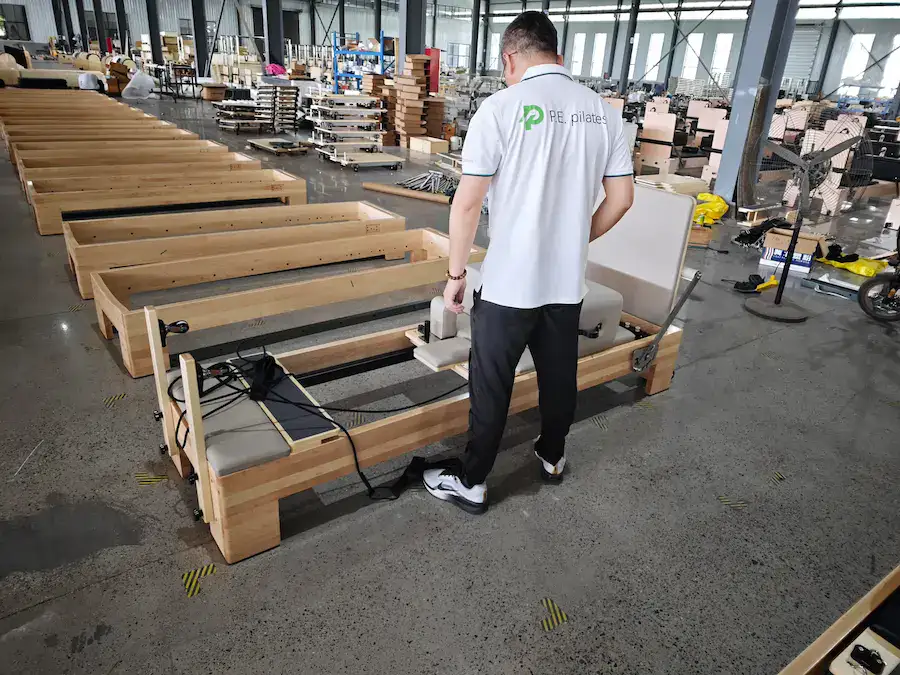
7. Packing is part of production quality
A reformer that passes factory inspection can still arrive unusable if moving parts are unsupported, painted or upholstered surfaces rub in transit, accessories move inside the package, or carton identity is unclear. The supplier should define where each loose item goes, how exposed surfaces are protected and how the unit or carton connects to the packing list.
For wholesale orders, review packaging together with the shipping plan. Factory price, packing dimensions, shipment method, destination handling and claims evidence all affect landed risk. The Pilates reformer wholesale guide explains how these decisions connect.

How the OEM and private-label process connects to production
OEM work adds decisions that must be settled before mass production. P.E.Pilates documents an eight-stage private-label workflow so customer requirements can be translated into one approved production version.
| OEM stage | Work content | Approval output |
|---|---|---|
| 1. Requirement review | Customer supplies product images, links, drawings, samples and channel requirements | Defined project brief and missing-information list |
| 2. Technical evaluation | Evaluate structure, materials, function and development feasibility | Feasibility decision and technical boundaries |
| 3. Quotation and specification | Confirm configuration, MOQ, quotation and production cycle | Commercial quotation tied to a written configuration |
| 4. Sample development | Produce, test and adjust a sample when applicable | Physical first article and correction record |
| 5. Sample approval | Customer confirms sample, logo, color and packaging | Approved reference and release decision |
| 6. Mass production | Produce the order to the confirmed version | Controlled production revision |
| 7. Quality inspection | Check function, appearance and batch consistency | Inspection result and correction/re-inspection record where needed |
| 8. Packaging and delivery | Apply customized packing, release shipment and provide after-sales support | Identified packing and delivery evidence |
How to compare pilates equipment suppliers
When buyers search for pilates equipment suppliers, catalogs and quotations often look more similar than the underlying production systems. Compare how each supplier controls the order rather than how many models appear online.
| Evaluation area | Strong evidence | Weak answer |
|---|---|---|
| Manufacturer identity | Business details, factory address, production scope and a live or recorded walkthrough tied to the supplier | Catalog images and an assurance that the company is “a factory” |
| Product definition | Controlled specification, BOM, drawings, approved sample and revision history | A model name, product photo and informal message thread |
| Material control | Supplier/material codes, incoming checks, lot records and approved references | Generic descriptions such as premium wood or high-quality leather |
| Production control | First-article approval, measurable in-process checks and written change approval | Inspection only after all units are finished |
| Final inspection | Model- and order-specific checklist with traceable results | A certificate template or photos without product identity |
| After-sales support | Model-specific parts list, diagnosis process and evidence required for claims | A broad warranty promise without parts or response workflow |
| Packaging and shipment | Approved packing method, package data, labels and pre-shipment evidence | “Export packing” without construction or dimensions |
Use these controls together with the 15 checks for choosing a Pilates reformer manufacturer in China. The objective is not to collect the most documents. It is to make the product, process and inspection result traceable to the same order.
What to verify when sourcing a Pilates reformer in China
China offers a broad manufacturing base, but country of origin does not answer the questions that determine product consistency. A “Pilates reformer China” search can surface factories, trading companies, brands, wholesalers and marketplaces. Buyers should first identify the seller’s role and then verify the production and quality responsibilities that apply to the order.
- Confirm who manufactures the product. Record the legal seller, factory name, production location and the party responsible for quality claims.
- Approve one exact configuration. Attach the specification, BOM, colors, accessories, branding and packaging to the order.
- Review a physical sample. Document every approved detail and every required correction before bulk production.
- Define inspection gates. Include incoming, first-article, in-process, final-function and packing checks where relevant.
- Control changes. Require written approval before a material, component, supplier or construction method changes.
- Plan replacement parts. Confirm part identity and compatibility for the delivered model revision.
- Keep shipment evidence. Connect unit or carton labels, packing photos and inspection results to the purchase order.
Red flags that deserve a pause before deposit
- The supplier will not identify whether it is the factory, exporter or trading company.
- The quotation lacks an exact model revision, included accessories or packaging scope.
- The sample is approved only through edited sales images.
- Materials are described only with marketing terms and no supplier or product codes.
- The factory promises that components may change without affecting the product but provides no comparison evidence.
- Inspection photos do not show the order, unit or batch identity.
- The warranty is presented without a claims process or model-specific parts support.
- The shipping quotation excludes the information needed to estimate landed cost and destination responsibility.
Frequently asked questions
Does a factory video prove that a Pilates supplier is reliable?
No. It can show production activity and help buyers understand the workflow, but reliability requires order-specific evidence: an approved specification, material controls, inspection records, change approval, packing evidence and after-sales capability.
Are all Pilates reformer China suppliers factories?
No. Search results can include manufacturers, trading companies, exporters, wholesalers and brands. Ask for the legal seller, production location, manufacturing scope and which party owns quality control and warranty responsibility.
What documents should I request before bulk production?
Request the final quotation, purchase specification, bill of materials or controlled component list, drawings where relevant, approved sample record, color and branding approvals, inspection plan, packaging specification and written change-control process.
How can I compare pilates equipment suppliers fairly?
Give each supplier the same product brief and ask for evidence against the same criteria. Compare configuration, materials, sample corrections, inspection scope, packaging, parts support, lead-time assumptions and landed-cost responsibilities—not unit price alone.
Should I inspect every reformer in a wholesale order?
The inspection scope depends on the feature and agreed quality plan. Identity, configuration and critical functional items may justify unit-level checks, while other characteristics may use an agreed sampling method. Define this before production instead of assuming that one sample represents the batch.
How do I reduce variation between repeat orders?
Retain a golden sample and physical material references, lock the current BOM revision, record material lots, approve changes in writing and compare the first article and finished batch with the same controlled references. See the guide to Pilates reformer production consistency for a complete repeat-order system.
Explore P.E.Pilates equipment and manufacturing support
Visit the P.E.Pilates homepage to review equipment categories, supplier information, OEM/ODM examples and support for studio, distributor and project buyers.