
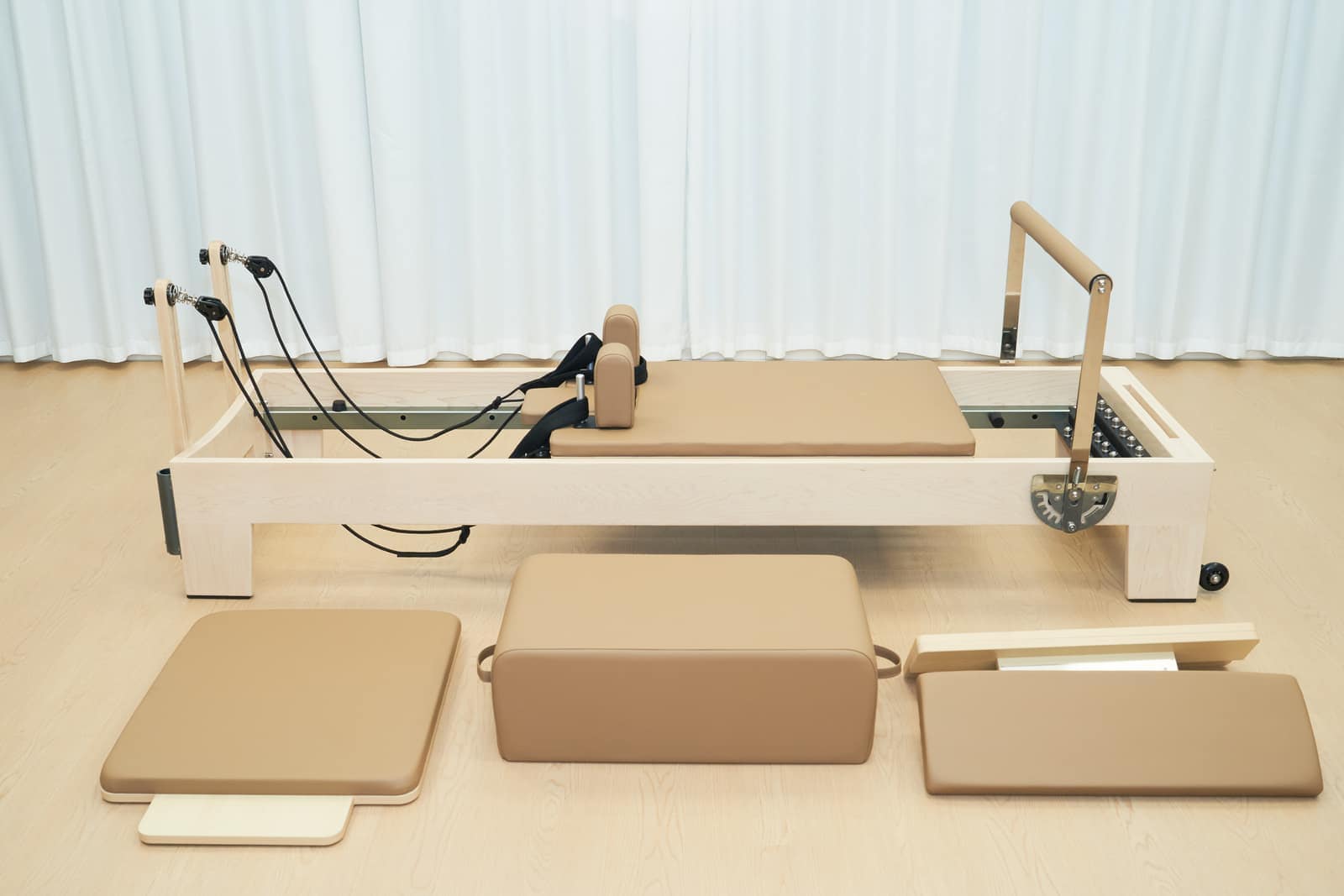
A commercial versus home Pilates reformer decision should start with how the machine will be used, not the label printed on the listing. A home reformer may be appropriate for one trained user, predictable settings, lighter scheduling, and compact storage. A studio machine must support different body sizes, repeated adjustments, cleaning between clients, back-to-back sessions, and a maintenance plan that does not interrupt classes. Before ordering, compare model-specific frame construction, carriage movement, spring and footbar adjustments, upholstery, replaceable parts, QC evidence, warranty terms, and delivery support. If a supplier cannot document those points, “commercial grade” is only a marketing claim.
Quick Comparison: Home Use vs Studio Use
| Buying factor | Typical home-use priority | Studio-use requirement | Evidence to request |
|---|---|---|---|
| Users | One or a few known users | Different heights, weights, and experience levels | Adjustment range and model specification |
| Schedule | Personal sessions | Repeated classes and fast changeovers | Intended-use statement and QC process |
| Frame | Storage and household fit may lead | Stability and repeatable alignment lead | Material, joints, frame inspection |
| Carriage | Comfortable personal feel | Smooth, consistent travel for many users | Travel test and wheel/rail inspection |
| Adjustments | Settings may remain unchanged | Footbar, ropes, headrest, and springs change frequently | Adjustment demonstration and locking check |
| Cleaning | Personal routine | Surface cleaning between clients | Upholstery care instructions |
| Service | Owner can wait for a repair | Downtime affects scheduled classes | Spare-parts list and response process |
| Delivery | Door access and assembly | Multi-unit unloading, installation, and opening date | Packing plan and delivery scope |
The table describes operating priorities, not universal specifications. Some compact reformers are designed for professional environments, while some full-size machines are intended mainly for personal use. Always verify the exact model.
Official product information supports this model-specific approach. Merrithew describes a professional MPX reformer that can be stored vertically while also stating that its At Home SPX is not warrantied for commercial use. Balanced Body describes the Allegro 2 as suitable for professional and home use. The conclusion is not that one manufacturer is better; it is that storage format and appearance do not define intended use. The product specification and warranty do.
The Real Difference Is the Operating Environment
In a home, the reformer normally has a small number of users. The owner learns one set of adjustments, follows a familiar cleaning routine, and can schedule maintenance around personal use.
A studio has a different operating pattern. Instructors may adjust the footbar, ropes, headrest, spring combination, and accessories several times per class. Clients have different proportions and movement experience. Machines may be placed in matched rows, so an inconsistent carriage or spring set is quickly noticed. A small service issue can remove a revenue-producing station from the timetable.
That is why a studio buyer should define the expected operating environment before comparing products:
- How many classes will run on a typical day?
- How many different clients may use each reformer?
- How quickly must instructors change settings?
- Will the room remain dedicated to reformer classes or serve multiple purposes?
- Who will inspect, clean, and maintain the equipment?
- How quickly can common wear parts be supplied?
These questions produce a better specification than simply asking whether a reformer is “professional.”
1. Frame and Stability: Check the Model, Not the Category
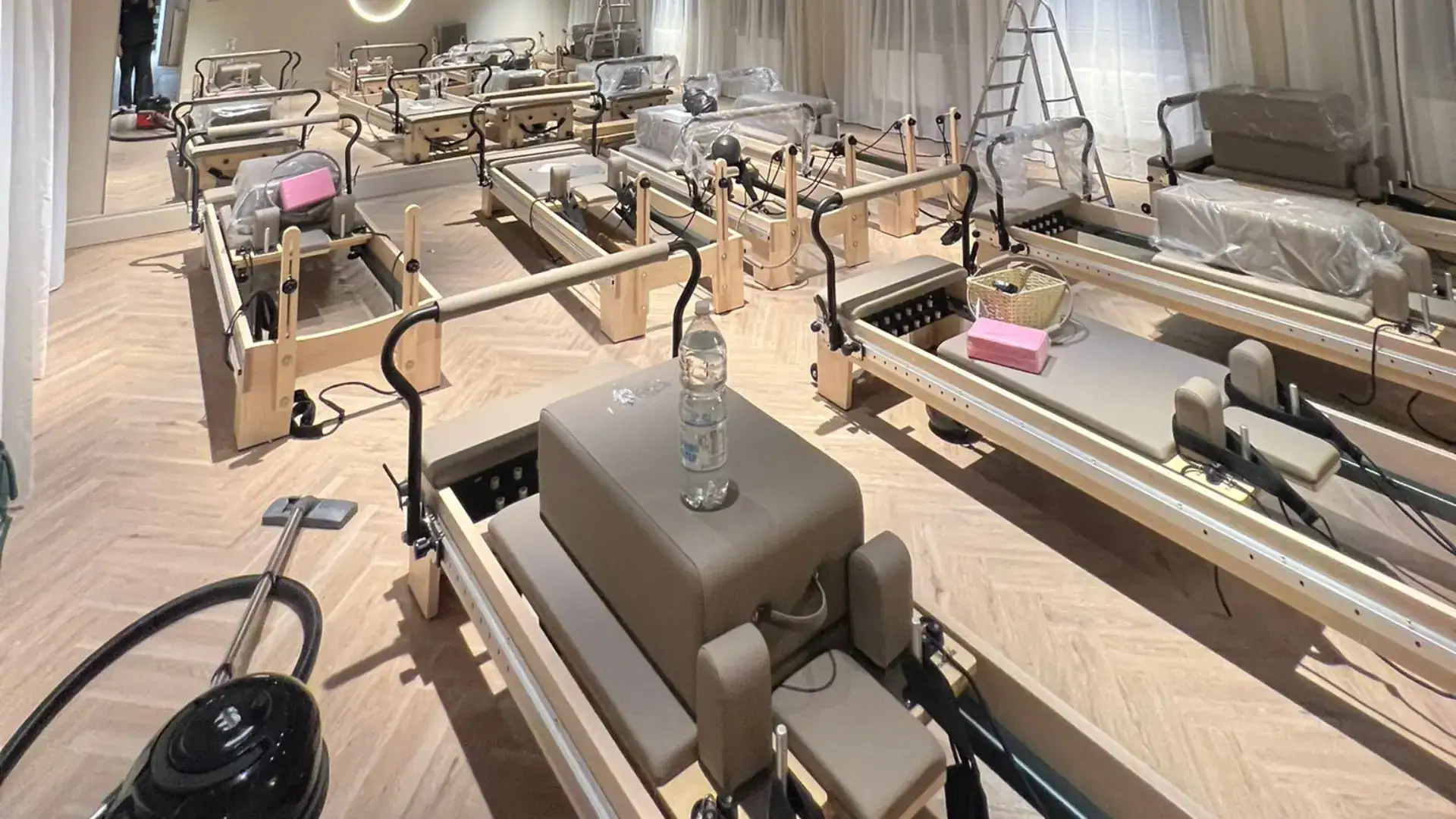
Frame material alone does not determine whether a reformer is suitable for a studio. Wooden and aluminum reformers can both serve professional spaces when their construction, joints, carriage alignment, and adjustment hardware are appropriate for the intended use.
P.E.Pilates offers wooden configurations using maple, oak, or walnut, with the exact wood confirmed by model specification. Buyers comparing a specific wood configuration can review the maple wood Pilates reformer page before requesting model-level drawings and specifications. Confirmed aluminum models use 6061 aluminum. Buyers should still ask for the specific model’s dimensions, construction details, and inspection records rather than transferring one model’s specification to an entire category.
Before ordering, check:
- Whether the frame remains level on the intended floor.
- Whether joints and tower connection points remain firm during normal movement.
- Whether the reformer shifts when users mount, dismount, or perform standing work.
- Whether feet or leveling components are replaceable.
- Whether the supplier can show the same production configuration that will be delivered.
Avoid unsupported rules such as “all heavy reformers are commercial” or “all folding reformers are home machines.” Weight, foldability, and material matter only in combination with construction and intended use.
Evidence Example From the Supplied P.E.Pilates Material Library
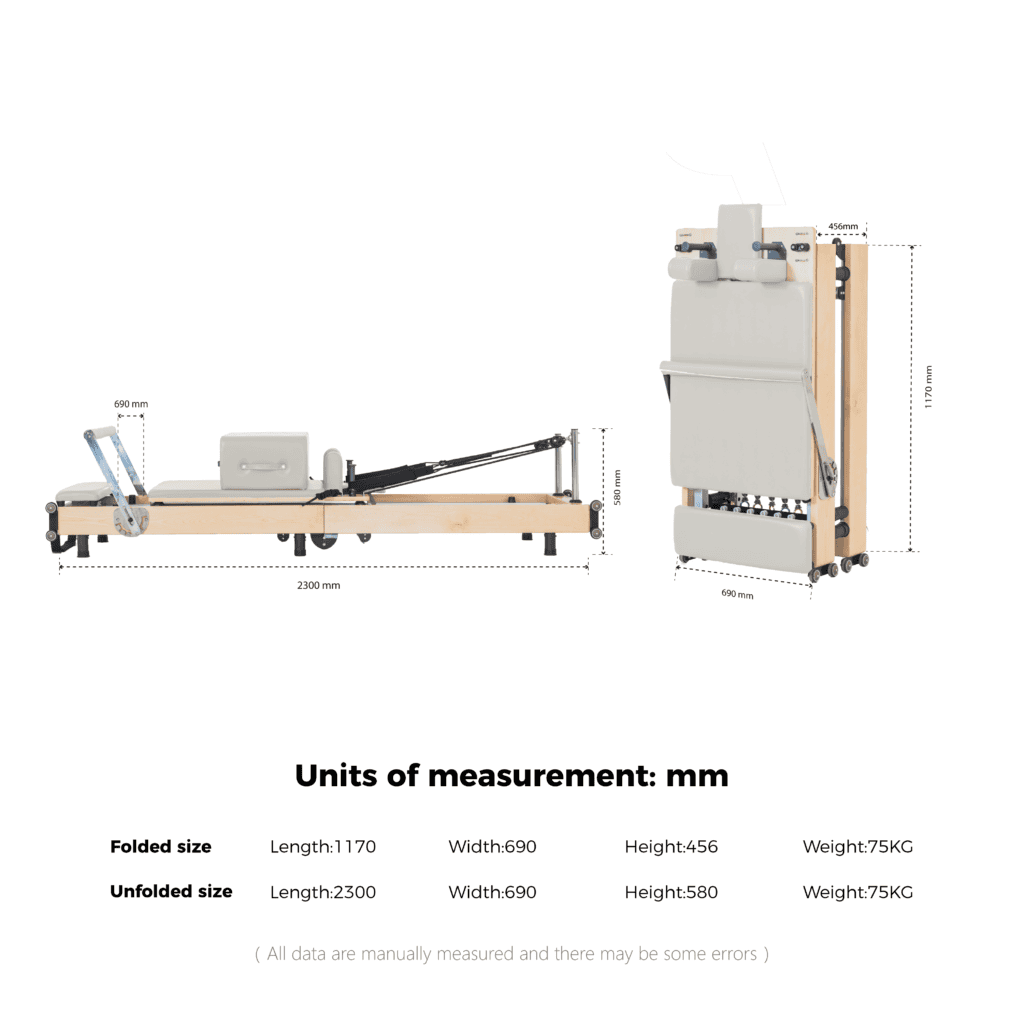
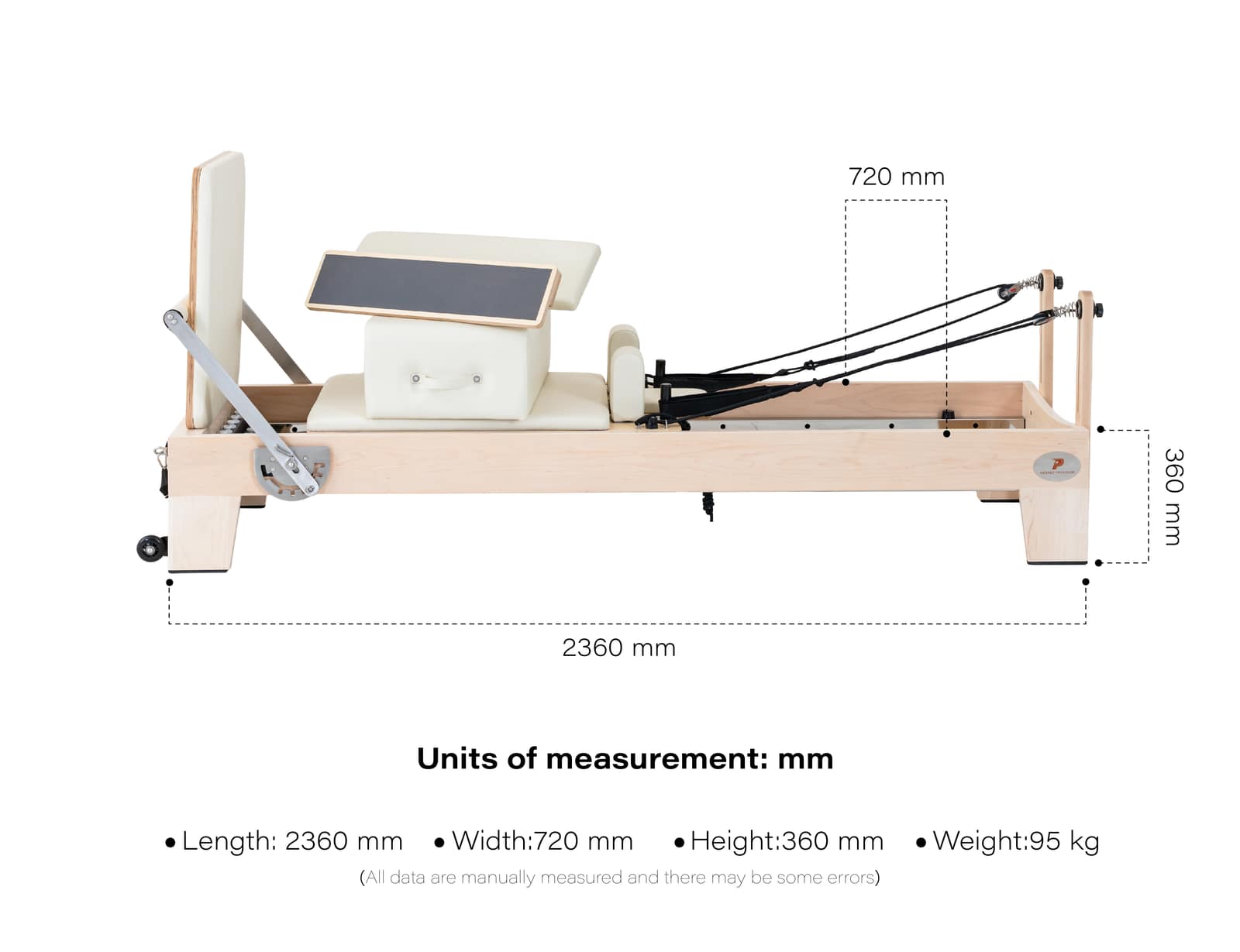
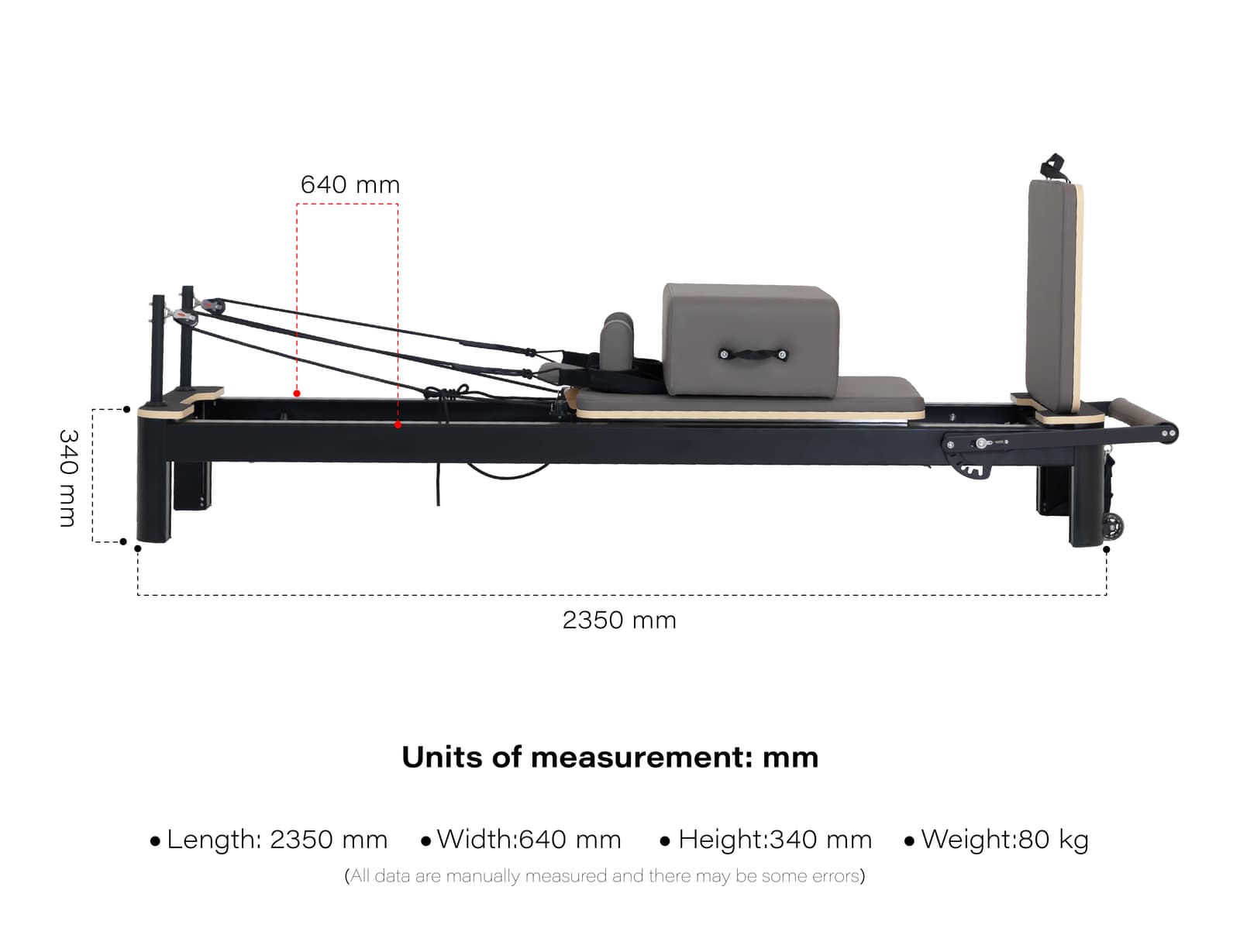
The supplied SKU library gives a useful example of why buyers must compare exact models rather than category labels. These are source-file measurements, not a claim that one model is universally “home” or “commercial.”
| Internal model example | Open dimensions | Stored dimensions | Source-file weight | What it demonstrates |
|---|---|---|---|---|
| FD-M foldable maple reformer | 2570 × 650 × 275 mm | 690 × 460 × 1500 mm | 65 kg frame; 6 kg box | Storage format adds operational questions that a fixed-only comparison misses. |
| WD-M fixed maple reformer | 2360 × 720 × 360 mm | Not presented as foldable | 95 kg | A fixed setup uses a different floor footprint and movement plan. |
| AL4 aluminum reformer | 2350 × 640 × 340 mm | Not presented as foldable in the cited dimension file | 80 kg | Frame material alone does not determine footprint or intended use. |
All three measurements must be reconfirmed against the final supplier specification before quotation or publication on a product page. The dimension graphics themselves state that measurements are manual and may contain small errors.
2. Carriage, Rails, and Class Consistency
Carriage feel is one of the fastest ways for a client or instructor to notice inconsistency. A studio buyer should evaluate the entire travel path, not only push the carriage once in a showroom.
Ask the supplier to demonstrate:
- smooth travel from the stopper to full extension;
- spring return without sticking;
- lateral movement or visible carriage play;
- wheel and rail condition;
- noise under the test conditions used;
- access for cleaning and replacement.
P.E.Pilates’ supplied fact sheet identifies PU pulleys and notes that quantity and structure vary by model. It also requires load, endurance, noise, and spring-resistance values to be confirmed by model before publication. For that reason, this guide does not assign an unsupported numerical noise or cycle rating.
3. Springs and Frequent Adjustments
A home user may keep a familiar spring combination for much of a session. In a studio, instructors change resistance repeatedly and need spring identification to remain clear across all stations.
For each model, request:
| Spring question | Why it matters in a studio |
|---|---|
| How many springs are supplied? | Defines the standard station configuration. |
| How are resistance levels identified? | Helps instructors make fast, consistent changes. |
| What resistance range and tolerance apply? | Prevents assumptions based only on spring color. |
| What inspection interval is recommended? | Supports a documented maintenance routine. |
| Are replacement springs stocked? | Reduces downtime after wear or damage. |
| Can spring test records be supplied? | Separates verified performance from general claims. |
P.E.Pilates identifies German piano-wire springs in its internal fact sheet, but the resistance range and tolerance still need to be confirmed for the selected model. Buyers should never assume that the same color represents identical resistance across different manufacturers.
4. Footbar, Rope, Headrest, and Accessory Changes
Repeated adjustment is a key commercial-use difference because it affects both class flow and wear points. During a sample review, ask several instructors—not only one salesperson—to operate the footbar, ropes, headrest, shoulder rests, and any tower components.
A useful test records whether:
- positions are easy to understand;
- locking points engage clearly;
- settings can be matched across multiple reformers;
- ropes travel without visible abrasion or tangling;
- frequently handled components can be cleaned;
- replacement instructions are available.
The best mechanism is not necessarily the one with the most settings. It is the one that supports the studio’s teaching method and can be adjusted consistently without delaying the class.
5. Upholstery and Cleaning Between Clients
Home buyers often choose upholstery mainly for comfort and appearance. Studios must also consider cleaning frequency, stitching, exposed edges, replaceability, and color consistency across a multi-unit order.
P.E.Pilates identifies automotive-grade microfiber leather in the supplied fact sheet and supports confirmed leather-color customization. Before buying, request the care instructions and confirm that the cleaning products used by the studio are compatible with the selected upholstery. Do not promise antimicrobial, medical, or infection-control performance unless the exact material and claim are supported by a relevant test report.
6. Space Saving Is Not the Same as Home Only

A foldable, stackable, movable, or vertically stored reformer may be useful in a professional multi-purpose room. A fixed reformer may be better in a dedicated class room where equipment remains in position.
The decision should be based on the operating plan:
| Room model | Questions to resolve |
|---|---|
| Dedicated reformer room | Is fixed placement more efficient for daily classes? |
| Multi-purpose studio | How long does setup and storage take between sessions? |
| Small boutique space | What are the stored dimensions and safe movement route? |
| Gym zone | Can members move equipment without supervision? |
| Distributor showroom | Which format best demonstrates target customer use cases? |
Confirm the open dimensions, stored dimensions, unit weight, approved storage method, wheel or handle arrangement, and floor requirements for the exact model. Do not use a generic folding-versus-fixed conclusion as a substitute for those specifications.
7. Maintenance and the Cost of Downtime
The purchase price is only one part of a studio’s equipment cost. A machine that cannot be used during scheduled classes creates operational cost even if the replacement part itself is inexpensive.
Ask for a service package that identifies:
- routine inspection points;
- cleaning and lubrication instructions, where applicable;
- common wear parts;
- parts diagrams or SKU references;
- warranty coverage by component;
- evidence required for a service request;
- first-response target;
- shipping method for replacement parts.
The supplied P.E.Pilates fact sheet states a 10-year frame warranty, two years for springs, one year for wheels and consumable parts, and one year for leather and upholstery. It also states a first response within 24 hours after the customer supplies photos or video. These terms should be checked against the final contract and the selected model before publication or ordering.
For Studio Owners
Use the Pilates studio equipment guide to coordinate reformers with room planning, complementary apparatus, delivery, and opening-stage procurement.
Choose around the room, timetable, teaching method, and maintenance capacity. A new studio should not automatically buy the maximum number of reformers that fit on a drawing. Instructor access, client movement, delivery routes, storage, and local safety requirements also affect capacity.
For a useful supplier comparison, give each supplier the same project brief: room dimensions, door access, target class size, classes per day, preferred configuration, opening date, and service location. This makes quotations and layout recommendations more comparable.
For Distributors
For channel planning, review the Pilates equipment wholesale program for distributors and compare branding, configuration, spare-parts, packaging, and repeat-order requirements. Selected customization examples are available in the OEM/ODM cases.
Do not create a simple “home” and “commercial” label without documented criteria. Define which models you will sell for single-user home use, professional multi-user use, or both. Keep model-specific dimensions, intended-use statements, warranty terms, spare-parts lists, and approved marketing claims in your catalog system.
For repeat orders, also confirm change control. Ask how the supplier communicates changes to upholstery, wheels, rails, springs, fasteners, packaging, or manuals. A good first sample is not enough if later batches arrive with undocumented substitutions.
Factory View: What Evidence Should Accompany a Commercial Claim?
Buyers can review the P.E.Pilates company and manufacturing background before requesting model-specific inspection evidence.
From a manufacturing point of view, a commercial claim should be supported by a defined product configuration and inspection process. Useful evidence includes material records, assembly and carriage checks, spring inspection, adjustment checks, upholstery inspection, packaging records, and pre-shipment photos.
P.E.Pilates’ confirmed process includes 100% outgoing inspection covering the frame, upholstery, carriage, springs, footbar, tower, and wheels, with photos taken at each step. Export orders use wooden-crate, moisture-resistant, and scratch-resistant packaging. Exact load, endurance, noise, spring-tolerance, and transport-test numbers remain model-specific and should be requested rather than inferred.
Commercial vs Home Reformer Buying Checklist
- Define users, sessions per day, class format, and room type.
- Confirm the model’s intended use in writing.
- Request exact dimensions, weight, configuration, and adjustment ranges.
- Test carriage travel, return, noise, and lateral movement.
- Operate all frequently changed settings several times.
- Confirm upholstery care and replacement options.
- Ask for spring specifications and replacement availability.
- Review component-level warranty terms.
- Request a spare-parts list and service process.
- Confirm packaging, unloading, installation, and delivery scope.
- Compare total operating cost, not only the first quotation.
- Record all unverified claims as pending before contract approval.
Final Recommendation
Choose a home reformer when the verified model fits controlled personal use, the user can manage setup and storage, and service delays will not disrupt a business. Choose a commercial reformer when the verified construction, adjustment system, QC evidence, parts support, and warranty match repeated multi-user operation.
The important word is verified. Studio buyers should not pay more merely because a product page uses “commercial grade,” and they should not reject a compact model merely because it saves space. Compare the exact model against a written operating brief.
Request Commercial Reformer Support
Send P.E.Pilates your room dimensions, class format, expected class schedule, preferred materials, and delivery location. Start by comparing commercial Pilates reformer configurations, then request a project-specific quotation and layout recommendation.
FAQ
What is the main difference between a commercial and home Pilates reformer?
The main difference is the operating requirement. A home reformer normally serves a small number of users, while a studio reformer must support repeated adjustments, different users, frequent cleaning, planned maintenance, and faster access to parts and service.
Is every heavy reformer commercial grade?
No. Weight alone does not prove intended use, stability, durability, or serviceability. Review the exact construction, adjustment system, QC evidence, warranty, and supplier support.
Can a foldable reformer be used in a studio?
Potentially, if the manufacturer confirms professional use and the model’s construction, setup process, stability, storage method, and service support match the studio’s schedule. Verify the exact model rather than relying on the word “foldable.”
Are wooden or aluminum reformers better for commercial use?
Both can suit commercial use. Compare model-specific construction, carriage alignment, joints, adjustments, maintenance requirements, appearance, and support. Material alone does not decide commercial suitability.
How should a studio test carriage quality?
Move the carriage through its full travel, observe spring return, listen under defined conditions, check for side-to-side play, and repeat the test across multiple units. Ask how wheels and rails are inspected and replaced.
What spare parts should a studio ask about?
Ask about springs, ropes, straps, wheels or pulleys, upholstery components, fasteners, footbar parts, and tower hardware where applicable. Request part references, lead times, and replacement instructions.
Does “commercial grade” have one universal Pilates-equipment definition?
Do not assume that it does. Ask each supplier to define the claim through intended use, specifications, inspection evidence, warranty terms, and service support for the exact model.
Should a studio compare unit price or total cost?
Compare total cost. Include configuration, delivery, unloading, installation, spare parts, maintenance, downtime risk, warranty boundaries, and replacement planning—not only the equipment quotation.