
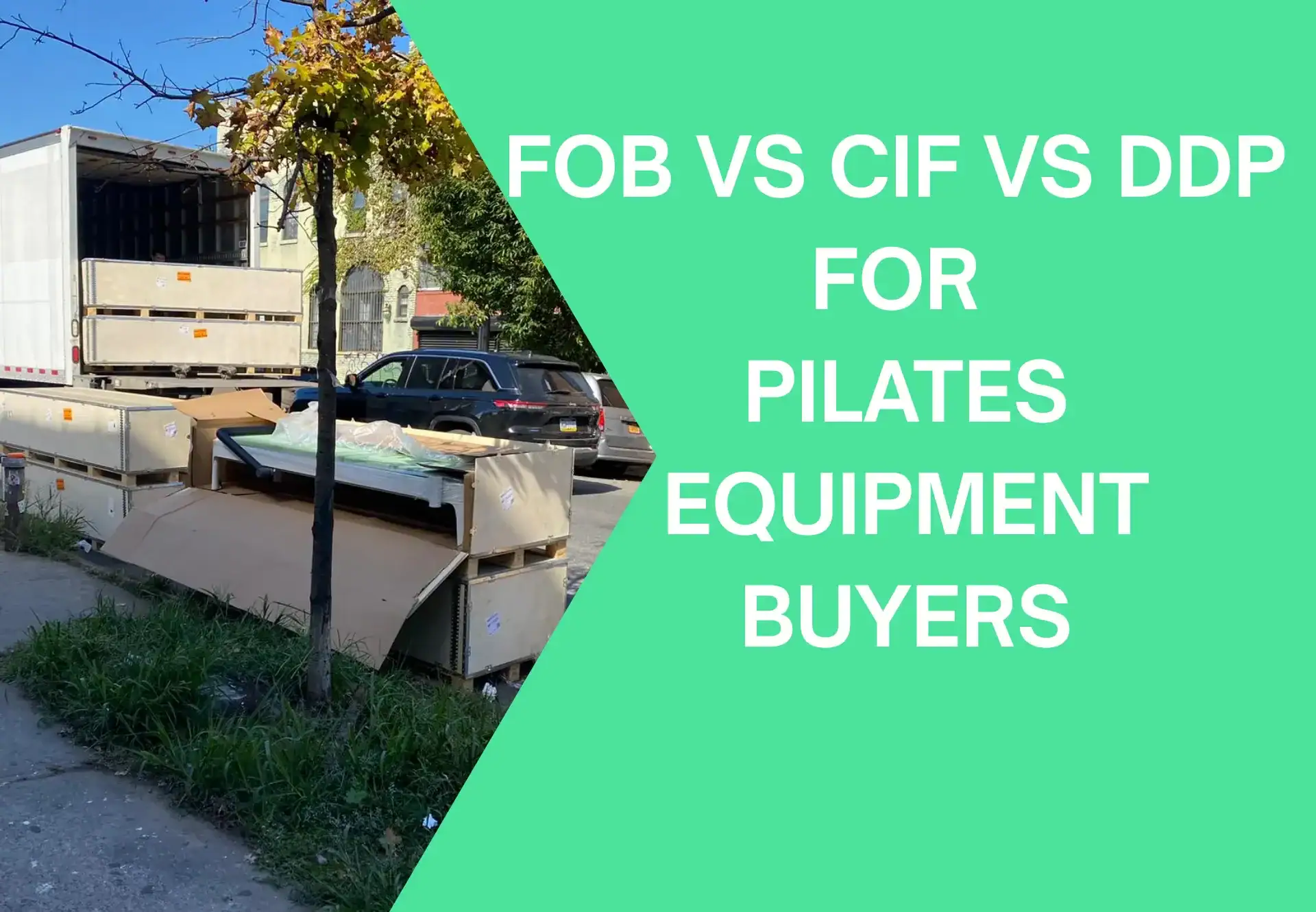
Direct answer: FOB vs CIF vs DDP for Pilates equipment mainly changes who controls the freight, who completes import formalities and when transport risk passes from seller to buyer. Choose FOB when you have an experienced forwarder and want control of the main shipment. Choose CIF when you want the seller to arrange ocean freight and minimum insurance to the destination port but can manage customs and local delivery yourself. Choose DDP when you want the seller to manage transport, import clearance and duties to a precise destination. For P.E.Pilates orders, the written DDP package includes unloading, movement into the agreed area and installation; white-glove delivery is quoted separately. Always compare the named place, insurance, destination charges and final delivery scope—not just the headline price.
Incoterms® rules define delivery responsibilities between seller and buyer. They do not replace the commercial reformer specification, payment terms, warranty, delivery-access survey or written service scope in the sales contract.
FOB vs CIF vs DDP at a glance
| Comparison point | FOB | CIF | DDP |
|---|---|---|---|
| Full name | Free On Board | Cost Insurance and Freight | Delivered Duty Paid |
| Permitted transport mode | Sea or inland waterway only | Sea or inland waterway only | Any mode, including multimodal transport |
| Seller arranges main international freight | No | Yes | Yes |
| Seller provides cargo insurance | No Incoterms obligation | Yes, minimum cover unless broader cover is agreed | No Incoterms obligation, although the seller bears risk to destination |
| Export clearance | Seller | Seller | Seller |
| Import clearance and import duties/taxes | Buyer | Buyer | Seller, where applicable |
| Risk transfers | When goods are on board the buyer-nominated vessel at the named origin port | When goods are on board the seller-contracted vessel at the origin port | At the named destination, with goods ready for unloading |
| Unloading under the ICC rule | Buyer after delivery | Buyer at destination unless covered by a separate carriage arrangement | Buyer unless unloading is included in the seller’s carriage contract or separately agreed |
| Typical buyer profile | Experienced importer with its own forwarder | Buyer who wants the seller to arrange ocean freight and minimum insurance but will manage import and final delivery | Buyer who wants one party to manage transport and import formalities to a precise destination |
The table summarizes the ICC Incoterms® 2020 rules. The named port or place and the exact edition should appear in the quotation, for example: FOB [named port], Incoterms® 2020 or DDP [full delivery address], Incoterms® 2020.
The point many buyers miss: cost and risk are not the same
CIF often creates confusion because the seller pays freight to the destination port while the transport risk transfers much earlier. Under CIF, risk passes to the buyer when the goods are on board the vessel at the port of shipment. The seller then pays the contracted freight to the destination port and obtains insurance for the buyer’s risk.
This means a CIF quote can include a destination-port freight cost without making the seller responsible for every loss event until arrival. The insurance certificate, insured value, exclusions and claims procedure therefore matter. ICC guidance also notes that the seller’s default CIF insurance obligation is minimum cover, commonly associated with Institute Cargo Clauses (C) or similar protection. Buyers needing broader protection should request it in writing.
FOB is more direct: both the main freight cost and transport risk move to the buyer’s side after the goods are on board at origin. DDP is an arrival term: the seller bears cost and risk to the named destination and completes import formalities, subject to local legal and operational feasibility.
What FOB covers for a Pilates equipment order
Under FOB, the seller prepares the order, completes export clearance and places the goods on board the vessel nominated by the buyer at the named shipment port. Risk then transfers to the buyer.
The buyer normally controls:
- Ocean freight from the origin port.
- Cargo insurance if required.
- Transit and import formalities after export.
- Import duties and taxes.
- Destination terminal and handling charges.
- Inland delivery, unloading, moving and installation.
FOB can suit an established Pilates equipment distributor or wholesale buyer that already has a freight forwarder, negotiated carrier rates and a customs process. It also gives the buyer more control over consolidation, sailing selection and destination handling.
It can be a poor fit when the buyer does not know which local charges to request or cannot manage a claim across several service providers. A low FOB equipment price is not a landed cost. The buyer still needs freight, insurance, customs, duties, destination handling and final-delivery figures.
A container-shipment caution
FOB and CIF are maritime rules intended for delivery on board a vessel. The ICC advises that FCA is often more appropriate for containerized or multimodal shipments when the seller hands the container to a carrier at an inland or port terminal before it is loaded on the vessel. Buyers should ask the forwarder and supplier whether the operational handover actually matches the selected rule.
What CIF covers for a Pilates equipment order
Under CIF, the seller:
- Completes export clearance.
- Loads the goods on board at the shipment port.
- Contracts and pays the freight to the named destination port.
- Obtains the required minimum cargo insurance for the buyer’s risk, unless the contract specifies broader cover.
The buyer normally remains responsible for import clearance, duties and taxes, destination charges not included in the seller’s carriage contract, inland delivery and destination services.
CIF can work when the buyer wants the supplier to arrange ocean freight but has a customs broker or local delivery partner at destination. It gives the buyer a freight-inclusive port quote without transferring import responsibility to the seller.
Before accepting CIF, ask for:
- The exact destination port.
- The freight inclusions and exclusions.
- The insurance certificate and coverage level.
- The party responsible for destination terminal charges.
- The free-time and storage conditions at destination.
- The customs broker and final-delivery plan.
The largest practical mistake is treating CIF as door-to-door delivery. It is normally a port-based term, and the buyer can still face customs, terminal, storage, delivery and unloading costs after arrival.
What DDP covers—and what must still be written into the quote
Under DDP, the seller arranges transport to the named destination, carries the risk to that point and handles export, transit and import clearance, including applicable import duties and taxes. ICC describes DDP as the rule imposing the greatest responsibility on the seller.
DDP can simplify procurement for a brand, retailer or studio equipment project without an established import team. It can also help a buyer compare a project closer to its delivered cost rather than comparing only factory or port prices.
However, DDP must name a precise delivery point. A country, state or city is not enough. The quotation should identify the postcode and final address, then confirm whether the vehicle can reach the site and what happens after arrival.
Does DDP include unloading, moving, installation or white-glove delivery?
Not automatically under the ICC rule. Standard DDP delivery occurs when the goods are placed at the buyer’s disposal at the named destination, ready for unloading from the arriving vehicle. The buyer normally unloads unless the seller’s carriage contract or sales agreement adds that service.
For P.E.Pilates orders, the written DDP service package includes unloading, moving the equipment into the agreed area and installation. These services must be shown in the quotation together with the destination and access conditions. White-glove delivery is an additional paid service because it requires a site-specific plan for appointment scheduling, access, internal placement, assembly, packaging removal and handover.
Before confirming a P.E.Pilates DDP quote, provide:
- Full delivery address and postcode.
- Commercial or residential delivery type.
- Loading dock, forklift or tail-lift availability.
- Doorway, corridor and lift dimensions.
- Stairs, turns and floor number.
- Required room placement and assembly scope.
- Site opening hours and appointment restrictions.
- Packaging-removal or white-glove requirements.
If these details change, the delivery scope and price may also change. The formal quotation controls the included services.
Real Aluminum reformer packing example
The AL-4 specification shows why packing data must be reviewed before comparing Pilates equipment shipping terms. Buyers can use the Pilates reformer quality inspection checklist to connect packing evidence with pre-shipment QC.
| Aluminum shipping input | Verified specification |
|---|---|
| Product size | 2350 × 640 × 340 mm |
| Product net weight | 80 kg |
| Packaging | Wooden case plus carton, double protection |
| Packing size | 2570 × 740 × 470 mm |
| Packing gross weight | 120 kg |
| Approximate packed volume | 0.89 m³ per unit |
The packed unit is 220 mm longer, 100 mm wider and 130 mm higher than the assembled product dimensions shown on the specification sheet. The 40 kg difference between net and gross weight reflects the packed shipment rather than the machine alone.
For freight planning, the 120 kg gross weight and 2570 × 740 × 470 mm crate are the relevant starting inputs. The 80 kg product weight is not sufficient for quoting transport, tail-lift capacity, unloading labor or internal movement. A final order may also require confirmation of crate count, palletization, accessories and whether several units can be consolidated.
This example does not create a universal freight price. Route, origin, destination, quantity, carrier, fuel and terminal charges, customs classification, duties, taxes and delivery services all affect the final quote.
Which term is better for different buyers?
Choose FOB when you want freight control
FOB may fit a distributor that has an experienced forwarder and wants to negotiate the ocean freight and destination services directly. The buyer must be able to manage insurance, customs and local delivery.
Choose CIF when you want seller-arranged ocean freight
CIF may fit an importer that wants the supplier to arrange freight and minimum cargo insurance to a destination port but already has a customs broker and local delivery partner. It is not a substitute for a landed-cost calculation.
Choose DDP when you want a destination-based project quote
DDP may fit a buyer that wants the seller to manage transport, import clearance and duties to a named address. It is most useful when the seller can legally and operationally act as the importing party in the destination country and when the quote defines unloading and site services.
Consider FCA or CIP for containerized and multimodal routes
Pilates equipment is often packed in crates and moved by truck, terminal handling and sea freight. If the seller hands the shipment to a carrier before vessel loading, FCA may better match a buyer-controlled shipment, while CIP may better match seller-paid freight and insurance. The correct rule should reflect the real handover point, not simply the most familiar three-letter term.
Quote checklist for Pilates equipment buyers
Send the supplier enough information to quote the whole route rather than guessing from a product price.
Product and order
- Exact model and configuration.
- Quantity and accessory list.
- Packing dimensions, gross weight and crate count.
- Stock origin or factory origin.
- Required production or dispatch date.
Trade and transport
- Incoterm and Incoterms® edition.
- Named origin port, destination port or delivery address.
- Freight mode and planned handover point.
- Insurance provider, insured value and coverage level.
- Export, transit and import clearance responsibility.
- Duties, taxes and customs-broker scope.
Destination service
- Terminal and handling charges.
- Final-mile vehicle type.
- Unloading equipment and labor.
- Moving path from vehicle to room.
- Assembly or installation.
- Packaging removal.
- Appointment or white-glove service.
- Exclusions, failed-delivery charges and storage exposure.
Buyers can place this checklist beside the model, MOQ and payment questions in the Pilates Reformer Wholesale Guide. For private-label specifications, use the separate Custom Pilates Reformer OEM/ODM Guide.
Common mistakes that increase landed cost or delivery risk
Comparing totals with different boundaries
An FOB price, a CIF port price and a DDP destination price do not cover the same work. Rebuild each quotation into the same cost layers before deciding which is cheaper.
Leaving the named place vague
DDP USA is not operationally precise. A delivery point should identify the full destination and, where relevant, the exact terminal, warehouse, dock or premises.
Assuming CIF risk stays with the seller to destination
Under CIF, the seller pays freight to the destination port, but risk transfers when the goods are on board at origin. Review the insurance before shipment.
Treating door-to-door and white-glove as synonyms
Door-to-door may end at the curb, loading area or accessible entrance. White-glove delivery can add appointments, internal movement, assembly, placement and packaging removal. The quotation must define the actual tasks.
Quoting from net weight or product dimensions
Freight providers need packing dimensions, gross weight and crate count. For the AL-4 example, the shipping basis is 2570 × 740 × 470 mm and 120 kg, not the 80 kg product weight. Record the same shipment data during pre-shipment quality inspection.
Ignoring import feasibility under DDP
ICC guidance warns that import clearance under DDP can create practical problems for a foreign seller. The seller must confirm that it can complete the required formalities in the destination country before promising DDP.
Frequently asked questions
Which Incoterm is best for Pilates equipment?
There is no universal best term. FOB can suit buyers with a forwarder and import team. CIF can suit buyers who want seller-arranged ocean freight to port. DDP can suit buyers who want the seller to manage the route and import formalities to a named destination. Containerized shipments may be better structured under FCA or CIP, depending on who arranges the main carriage and insurance.
Does DDP include unloading and installation?
Not automatically under Incoterms® 2020. DDP delivery is normally completed with the goods ready for unloading at the named destination. The written P.E.Pilates DDP service package includes unloading, internal movement and installation. White-glove service is quoted separately.
Is door-to-door delivery the same as white-glove delivery?
No. Door-to-door describes the transport route but does not necessarily include internal placement, assembly or packaging removal. White-glove delivery requires a separately defined and priced service scope.
What destination charges are excluded from CIF?
The answer depends on the seller’s freight contract and the port. Import clearance, duties, taxes, terminal charges, storage, customs-broker fees, inland delivery and unloading may remain on the buyer’s side. Request a written destination-charge breakdown before accepting the quote.
Does CIF include full cargo insurance?
Not by default. Under Incoterms® 2020, CIF requires the seller to obtain minimum insurance cover unless the parties agree on broader protection. Buyers should review the certificate, insured amount, exclusions and claims process.
When does risk transfer under CIF?
Risk transfers when the goods are on board the vessel at the port of shipment, even though the seller pays freight to the named destination port.
What information is needed for a DDP Pilates reformer quote?
Provide the model, quantity, full address, postcode, delivery type, access constraints, floor, lift and doorway dimensions, unloading resources, room-placement requirement and installation or white-glove scope.
How much shipping space does one AL-4 reformer require?
The reference AL-4 crate measures 2570 × 740 × 470 mm, or approximately 0.89 m³, with a gross weight of 120 kg. Final shipment planning must still confirm crate count, consolidation and the actual order specification.
Request a route-specific shipping quote
A useful quote should make the handover point, cost boundary and destination service visible. Send P.E.Pilates the model, quantity, destination postcode and required delivery scope. We will review the packing inputs and prepare the applicable shipping option for your project.