

A custom Pilates reformer sample should be approved only when it can serve as a measurable production standard—not simply when it looks acceptable in photos. Before authorizing a bulk order, buyers should confirm the sample’s structure, dimensions, carriage movement, spring resistance, upholstery, branding, accessories, packaging and documentation. Record every approved detail in writing, attach dated photos and videos, and identify which items must remain unchanged during mass production.
This checklist is designed for Pilates brands, distributors, retailers and studio groups preparing to approve a private-label or OEM reformer sample. Buyers still comparing configurations can review our commercial Pilates reformer range before defining the sample.
The approval rule
Approve measurable specifications and documented evidence. If a requirement cannot be checked during production or final inspection, clarify it before signing the sample approval.
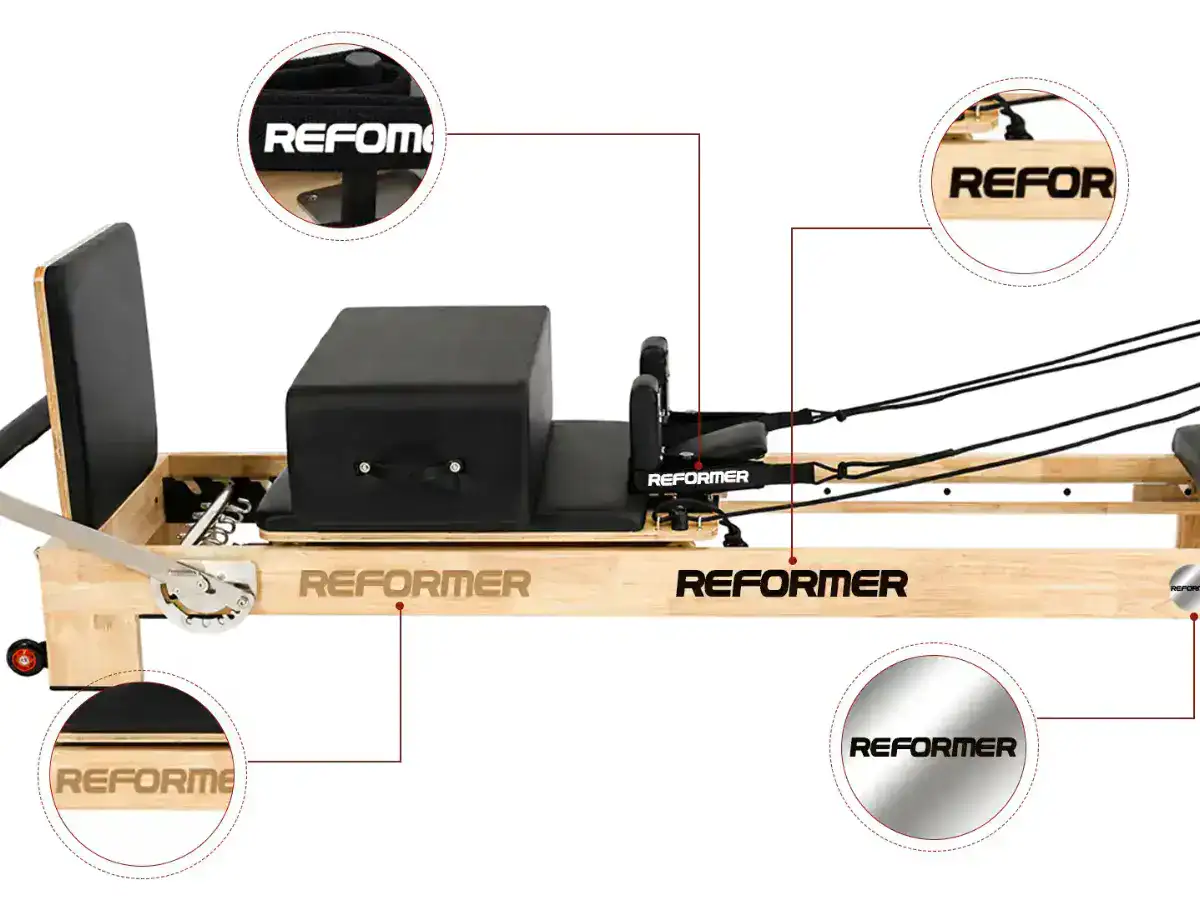
Custom Pilates reformer sample approval at a glance
| Decision | When to use it | What happens next |
|---|---|---|
| Approved | All safety, function, appearance and packaging requirements match the agreed specification. | The signed sample and specification become the production reference. |
| Conditionally approved | Minor, clearly documented corrections are required but do not justify another complete sample. | The supplier confirms each correction in writing and provides evidence before production. |
| Rejected | A safety, structural, functional or major branding requirement is incorrect. | Correct the design and inspect a revised sample before bulk production. |
Do not use a vague instruction such as “make production the same as the sample.” The approval record should state exactly which specifications, tolerances, colors, materials and test results the sample represents.
1. Confirm the approved specification sheet
Start by comparing the physical sample with the latest approved specification—not with an early quotation or chat history. Confirm the model number, frame material, overall dimensions, carriage dimensions, machine weight, user-weight rating, spring set, upholstery specification, rope system, accessories and packaging configuration.
Mark the document with a revision number and approval date. If a dimension or component changes after sampling, update the specification before production begins.
2. Measure the frame and critical dimensions
Measure overall length, width and height as well as the carriage, footbar, shoulder rests, headrest, standing platform and any tower components. Check that adjustment positions are usable and repeatable. For a multi-model order, identify which dimensions are shared and which are model-specific.
Small dimensional changes can affect packaging, container loading, studio layouts and replacement-part compatibility, so record actual measurements rather than relying only on visual approval.
3. Inspect frame construction and finish
Check joints, fasteners, welds, wood surfaces, aluminum profiles, coatings and exposed edges. The reformer should sit level without rocking. Inspect for cracks, gaps, sharp edges, uneven coating, color variation, loose hardware or visible repair marks.
For wooden reformers, approve the wood species, visible grain range and finish sample. For aluminum models, approve the profile, surface treatment and acceptable color tolerance.
4. Test carriage travel and wheel alignment
Move the carriage repeatedly through its full travel. It should run smoothly without binding, lateral movement, scraping or unusual noise. Check the carriage wheel material, bearing movement, rail contact and stopper position.
Record a short video from the side and from the end of the machine. This gives the production and quality teams a practical reference for acceptable movement and sound.
5. Verify springs and resistance consistency
Confirm the spring quantity, color coding, attachment hardware and intended resistance levels. Test each spring connection and compare resistance across matching springs. Springs should not show deformation, surface damage, abnormal noise or insecure hooks.
If your brand uses a unique resistance system, define an acceptable measurement method and tolerance. Color alone is not a sufficient production standard.
6. Check the footbar and adjustment mechanisms
Test every footbar position, locking point, adjustment knob, gearbar position and removable component. Adjustments should be intuitive, secure and consistent on both sides. Check that hands are protected from obvious pinch points during normal adjustment.
Include photos of every approved setting and identify any installation or operating warnings required in the manual.
7. Approve upholstery, foam and stitching
Approve the upholstery color under consistent lighting and retain a physical color reference when possible. Check texture, sheen, thickness, cleaning suitability and resistance to visible marking. Inspect foam density and comfort on the carriage, headrest and shoulder rests.
Stitching should be straight and consistent, with secure corners and no loose threads, wrinkles or exposed staples. Define where seams, logos and labels must be positioned.
8. Verify ropes, straps, pulleys and accessories
Confirm rope length, rope material, adjustment range, double-loop straps, handles and attachment hardware. Test the guide pulleys for smooth rotation and correct alignment. List every included accessory and its quantity so that the packing list matches the approved sample.
If accessories are sourced separately, record their supplier specification and compatibility rather than treating them as interchangeable generic parts.
9. Approve branding and private-label details
Check the logo artwork, dimensions, placement, color, print or engraving method and orientation. Review brand labels, warning labels, model labels, serial-number format, carton marks, manuals and warranty cards.
Use production-ready vector artwork and identify the approved color system. A screenshot or compressed image is not a reliable logo standard. For a broader view of customization choices, see our OEM/ODM customization guide.

10. Review safety, stability and load-related checks
Test the sample on a level surface and inspect stability during representative movements and adjustments. Confirm that fasteners remain secure, moving parts clear the frame correctly and stoppers engage as intended. Check warnings and operating instructions against the actual product.
Any required compliance testing should use the final production-intent design and materials. A visual sample approval is not a substitute for applicable testing, documentation or market-specific requirements.
11. Conduct assembly and packaging trials
Follow the proposed assembly instructions using the tools and hardware included with the sample. Record unclear steps, missing labels or difficult adjustments. The packaging trial should verify component protection, carton dimensions, hardware organization, accessory count and carton markings.
Pay particular attention to exposed corners, rails, upholstery and parts that can move during transport. Photograph the packing sequence so it can be reproduced during bulk production.
12. Create the golden-sample approval record
The final approval package should include the signed specification, dated photos and videos, measured dimensions, color references, logo artwork, accessory list, packaging layout, manual version, test notes and a list of required corrections.
Assign responsibility for storing the physical reference sample. If the buyer and manufacturer each keep a sample, record their serial numbers or labels so both parties refer to the same approved configuration.
Sample approval record: minimum fields
| Record field | What to capture | Approval evidence |
|---|---|---|
| Product identity | Model, revision, date and sample label | Specification cover page and product photos |
| Dimensions | Overall and critical component measurements | Measurement sheet with tolerances |
| Function | Carriage, springs, footbar, ropes and adjustments | Test notes and dated videos |
| Appearance | Frame finish, upholstery, stitching and logo | Color reference and close-up photos |
| Included items | Accessories, tools, spare hardware and documents | Approved packing list |
| Packaging | Protection, carton marks and packing sequence | Packed-sample photos and carton dimensions |
| Disposition | Approved, conditionally approved or rejected | Named approvers, date and correction list |
What should remain unchanged after approval?
Define change-control rules before production. The manufacturer should obtain written approval before changing any safety-critical component, structural material, spring specification, wheel or bearing type, upholstery specification, logo method, accessory set, packaging method or manual version.
If an approved component becomes unavailable, assess whether the substitute affects function, appearance, compliance, replacement parts or customer instructions. A photo comparison may be adequate for a minor packaging change; a revised physical sample may be necessary for a structural or functional change.
How sample approval connects to bulk inspection
The approved sample establishes the reference, while bulk inspection verifies that production follows it. The purchase order and quality plan should define inspection stages, sampling method, acceptance criteria and evidence requirements. Use the separate Pilates reformer quality inspection checklist for bulk orders when preparing pre-shipment checks.
For PE Pilates custom programs, the usual workflow is requirement confirmation, sample review, written approval, production and final inspection. Bulk orders start from five units, and buyers can purchase one sample before placing the bulk order. Dropshipping is not provided.
Frequently asked questions
Is a video inspection enough to approve a reformer sample?
Video can verify appearance and basic operation, but it may not confirm dimensions, resistance, material feel, comfort or packaging performance. Buyers should decide which requirements need physical inspection before approval.
Can production begin with a conditional approval?
Only when every correction is specific, measurable and confirmed in writing. Structural, safety or major functional issues should normally be corrected and rechecked before production.
Who should sign the approval record?
The buyer’s authorized product or purchasing representative and the manufacturer’s responsible project or quality representative should be identified. The record should include the approved revision and date.
Should the approved sample be kept after production?
Yes. Retaining the approved reference helps resolve questions about acceptable appearance, dimensions, components and replacement-part compatibility during production and after-sales support.
Prepare your custom reformer sample with PE Pilates
Prepare Your Custom Reformer Sample
Send us your target model, branding files, material preferences, market requirements and expected quantity. We can confirm the sample scope and approval path before production.